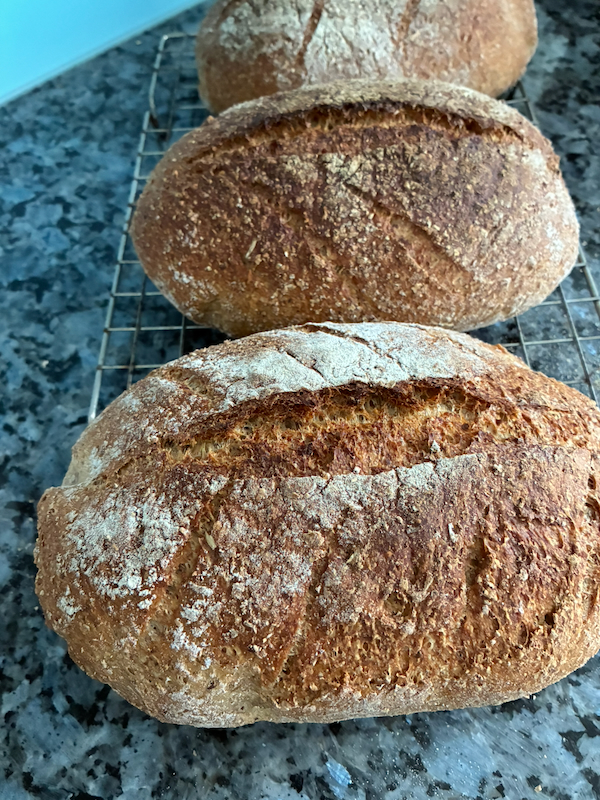
A wonderful mixture of wholemeal flour and buttermilk. Buttermilk is an essential ingredient in making scones light and fluffy. Adding the buttermilk to the wholemeal dough lightens the crumb in the same way and makes it all the more delicious. Buttermilk is stocked by many key British supermarkets.
You can, of course, make these into rolls – just image them with delicious lunch ingredients. Just make sure you buttermilk is warmed before adding to the mixture. The liquid content should be approximately 22C.
If you’ve not autolysed (soaked) your dough before kneading, this not only makes it easier to knead but improves the flavour, do try it.
Buttermilk Bread
Many buttermilk bread recipes are made with white flour. Using wholemeal give a whole different texture. Depending on the wholemeal flour you use, you may want to add an extra 20 ml water if it is very firmAutolysing (or soaking) the recipe makes it easier to knead. You will find the dough sticky, it is supposed to be like that!
Equipment
- 2 Cast iron pans/ Dutch oven with lid at least 23cm wide
- 1 Digital scales
- 1 Dough scraper
- 1 Lame
- 1 Stand mixer
- 1 Large box to store dough in fridge
- 1 Couche
Ingredients
- 500 grams wholemeal flour
- 300 grams white bread flour
- 250 ml buttermilk warmed to 22° C (71°F)
- 210 ml water at 22° C (71°F)
- 12 grams salt
- 8 grams instant dried yeast
- 10 ml honey
Instructions
Autolysing the dough
- Add the flours and the yeast to a bowl. Add the buttermilk and water. Mix together and leave for 30 minutes.

Mix and Knead the dough
- Add the salt to the soaked mixture and mix well. Add the honey. Using a stand mixer, knead until the dough reaches between 24° and 26°C (75° to 78°F). Start on a low speed then the scalded mixture in lumps. Mix for about 5 minutes, then increase speed to medium.
- The dough should come away from the sides cleanly. Check that the dough is elastic by pulling a lump gradually apart. Checking the dough temperature is very important. This will set you up for a successful dough.
- The dough should ideally be between 24° and 26°C (75° to 78°F)
- Alternatively, knead for 10 to 15 minutes until smooth and the dough is stretchy.
First Proving at Room Temperature
- Move the dough to a large plastic box and leave it to prove for 1.5 hours at room temperature. Alternatively, put it in the fridge and leave overnight.
Shaping the dough
- After the dough has proved, divide the dough into two and shape the dough gently into a round. Leave 10 minutes.

Pre heat your oven and pans
- Pre-heat your oven to 230°C (445°F) placing your cast iron pans in the oven. Do this at least 1/2 hour before you intend to bake.
Shape and Second Prove
- Shape your loaves a second time. If your pan is circular, shape into rounds; if you pan is rectangular shape into oblongs. Place on a couche for one hour.
Prepare parchment paper
- Cut two strips of parchment paper as wide as the loaf and twice as long. You will put your dough on the parchment and place in the cast iron pan.
Transfer your dough
- After one hour, transfer the dough to the parchment paper. Place the parchment on top of the dough, then a cutting board on top and then invert it.

Score the loaves
- Using a lame, score the loaf horizontally. with a shallow cut to one side about 3/4 the way across the loaf.

Bake
- Remove the pans from the oven and remove the lids. Put the loaves into the pan and close the lid immediately.
- Place in the oven and bake for 25 minutes. Then remove the lid and bake for a further 10 minutes. Finally, bake for 5 minutes out of the pan. Let it cool before eating.

Notes
This recipe assumes some knowledge of breadmaking techniques. Consult my series of posts, Bake Better Bread for more information.
For the bread baking equipment mentioned, check out my suggestions.
Tried this recipe?Mention @Breadbakerdani or tag #SevernBitesBreadmaking!